This entry won’t be filled entirely with the super cool stuff that we did this weekend. That stuff comes at the end, along with some amazing pictures, but you have to read my intellectual stuff first.
Our dean has asked us to compare the different healthcare systems we’ve experienced, and that’s what I’m going to do here(, and there will probably be a similar entry later from Libby... only a lot more insightful). It’s hard to isolate the healthcare system from the rest of society, so the comparison will be on a slightly broader scale.
So, Nicaragua, El Salvador, and Costa Rica all have their own unique needs. All tout universal healthcare, though none do it perfectly. Costa Rica seemed to do it the best, though when you decide to not have an army and to devote all your national defense budget to healthcare and education, that makes sense. Its biggest flaw, from what I saw, was their inability to reach out to illegal immigrants. Not unlike in the US, technically immigrants are allowed healthcare, but they don’t seek it because of fears of deportation. Costa Rica also has the benefit of a good infrastructure and the continual income that ecotourism brings.
Nicaragua has different issues. They don’t have many illegal immigrants, and they seem to have a decent supply of resources (which is surprising, considering that their biggest source of income is money sent to individual families by illegal immigrants in the US). Their biggest challenge is the rainy season. The clinic where we worked is isolated from basically the rest of the world for several months each year. Wanna have a baby in that situation? Or get in a car accident? Or even just get a bad case of diarrhea? A few engineers and hundreds of thousands (or perhaps millions) of dollars would fix that with the construction of tons of very stable bridges, but it just isn’t feasible. There are so many rivers that would need bridges built, and each one, we’re told, costs at least tens of thousands of dollars using local supplies and workers.
El Salvador is like a mini United States. And that’s the attitude of people here. It’s a little United States because that’s what they strive so hard for it to be, but they all want to live in the big United States. I think that El Salvador’s problems are most similar to the US’s in terms of health care. They don’t have impassable rivers during the rainy season (that I know of). They don’t have many illegal immigrants. Their problem is that they don’t have their own currency. That sounds weird, but let me explain.
They use the US dollar as their national currency. Their economy is in shambles. There is a huge discrepancy between the haves and the have-nots. There are 13 families in the country who own basically everything: malls, movie theaters, coffee plantations, hotels... everything. There was a civil war here in the 80’s that was quite gruesome, and that helped things a little, but not a ton. The pre-war government formed the political party Arena, which has maintained power ever since the war, so not much has changed. The guerrilla fighters from the war formed the political party FMLN, and they haven’t been able to obtain much power, though apparently they recently made some progress in getting senate seats, and their presidential candidate stands a chance in the March election.
 An Arena demonstration on the street
 The resulting traffic jam
So, the translation in terms of healthcare is the following: the haves get great private healthcare. The have-nots have to go to either social security type hospitals (if their job is good enough to pay into the system) which are apparently pretty decrepit, or they can go to the public hospitals and have to share a room with a dozen other people and maybe not get seen by a doctor for a day or two. For the females reading this, imagine giving birth in a room with 4 or 5 other women in labor, possibly without a curtain separating you. Pretty fancy, huh? Resources are scarce, and they’re definitely not distributed equally.
The other arm of this is that there is an excess of doctors who all want jobs in the private hospitals because they pay well, but since those are so hard to come by, they only go to people who are trained abroad. That means that doctors who train in El Salvador often leave to the US or Cuba or Costa Rica or wherever else so that they can get specialty training elsewhere. And once you leave El Salvador... can you imagine having the opportunity for a LEGAL job in the US and passing it up?
After contemplating all this, it makes the US sound pretty nice, huh? But we’ve run into some Australians on vacation while we’ve been here, and one of them put it pretty simply to me: “America! Such a developed nation, and yet it doesn’t provide healthcare to all its citizens?!? What are they thinking?”
What’s the number these days? The last I heard was 40 million US citizens without insurance, but that was before the recession. We don’t have a rainy season. We don’t have a shortage of supplies like these other countries do. What’s our excuse? Or the much better question, how do we start to change?
It reminds me of a house visit we did today in the community. A poor girl who is three years old, went her entire third year of life without gaining a single pound. That’s not supposed to happen. Parasites, malnutrition, and who knows what else have been plaguing this girl for a long time. The house visit was depressing: trash everywhere, no organization to the house, food left out uncovered, no clean dishes, kids with dirty hands, chickens all over the place (including in the house), huge barrels filled with water that looked like mosquito-larvae-olympics, visible parasites swimming in the sink, no running water today... Where do you start with that? What do you tell them to do first? The first twelve things you suggest to them probably will have little impact because there are the 38 other things remaining that need to be changed, so how do you get enough of them changed before they give up because it’s not making a difference?
Anyways, that’s my suave transition into the more lighthearted portion of the post: what we’ve been doing. This weekend, Libby and I had quite an adventure. We went to Tacuba (tacuba, ahuachapan, el Salvador if you’re google mapping it) for a “waterfall hike” on Saturday. We were warned ahead of time that it was only for the “strongest FIMRC volunteer,” and we definitely found out why.
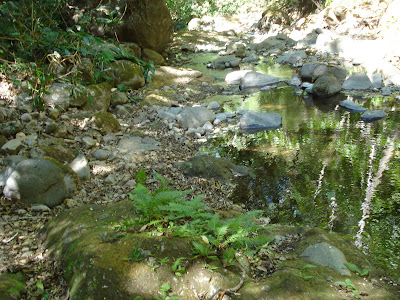
Most of the trip, we were either on a nonexistant trail, or wading through a river, or perhaps on the edge of a huge cliff. It was on the edge of one of these cliffs that I had a little scare. Those leaves on the ground were a safe place to step, right? But when I put my foot there, it turns out they weren't really resting on anything and my foot just keep going. Luckily, I had already been clinging for dear life onto a root that was traversing the wall in front of me, so no harm was done. That was a pretty typical experience for the hike. We were told that no one has ever died on this hike, and I find that fact amazing. But it must be true, since the Lonely Planet travel book sings the praises of our guide.
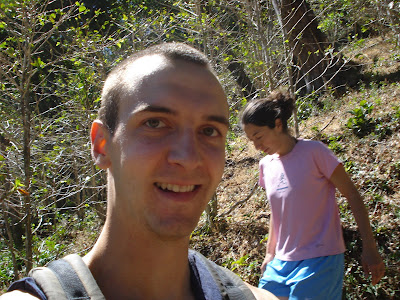 A picture from a calmer moment in the hike
 This picture hardly does the non-existent, super-steep trail justice
But what did this life-endangering trail lead to? A pretty view? A calm picnic lunch? Well, not exactly. You see, we were going to be jumping off of water falls. That's what this hike was all about. Apparently that's what our guide does every day. He takes tourists out (or goes by himself, if there's no one around) and hikes from waterfall to waterfall and jumps in from insanely high heights.

I like the picture above because Libby's face reflects just how crazy it seemed to jump as our guide (in the foreground) described. He would sit on the edge, throw a rock over the edge of the cliff into the water below, and say, "Aim for there." Some times he would add particularly comforting instructions like, "Tuck your legs in," and he would leave the translation (because it's shallow and otherwise you'll break your ankle) to us. Or he might add, "Don't jump too far and hit that log," or "It's really slippery so don't slip as you're jumping."
He knew what he was doing, though. The first jump was a fairly benign 5 or 8 meters or so, and it was nice and deep, not too many obstacles. So, he used it and the second jump to determine who was capable of making the more difficult jumps. The two girls in the group (Libby and another gringa) were not allowed to do the most challenging jump, and instead, they repelled down.
 Suiting up to repell down a waterfall
That reminds me, though. One of the cool features of the hike is that for the 5 hikers, we had four guides. They carried all of the repelling equipment (harnesses, ropes, etc.), lunch (sandwiches for all), as well as the hikers' backpacks, so that we could occasionally have access to our stuff (cameras, bug spray, etc.) between jumps. It was very convenient. But since we didn't always have our stuff, we didn't get pictures of everything, but we got some good ones.
The jump pictured below was pretty challenging. The target was kind of narrow (don't hit the log by jumping too far, make sure you jump over the rocky cliff below). The rock from which I jumped sloped downward probably about 25 degrees. And I was the last one to go, so everyone's wet butts had sat on the rock, decreasing whatever traction I may have had to begin with.
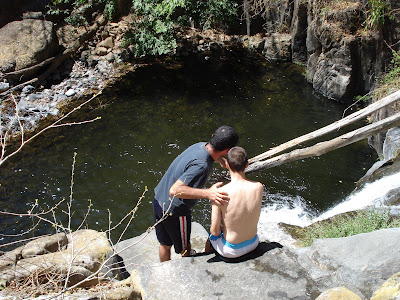
So, I got lots of instructions and helpful hints (like the part of the rock furthest from the edge was more level, and notice that small patch of dry rock that you could step on)
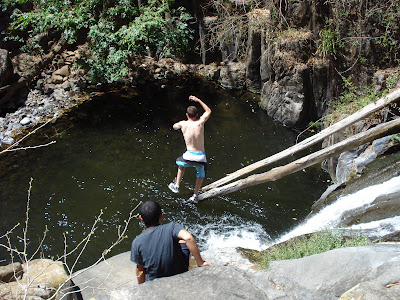
And then I was off!

And wouldn't you know it? I survived!
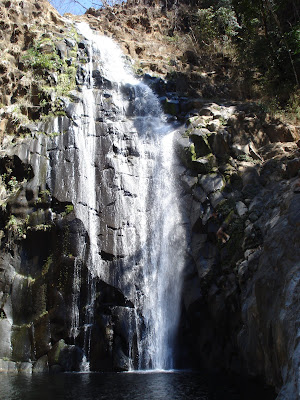
And the only injury of the day was very very mild. The falls pictured above were the biggest jump. We jumped from about halfway down, the cliff on the right of the picture. It was the tallest jump... about 15 meters. When I landed, it almost felt like I had twisted my ankle. I think the force was just so strong as I hit the water that it stretched things out a little. After a few minutes, though, it felt better, and I was well enough for the hour-long straight uphill steep treacherous hike to the waiting pick-up truck to take us back to Italo (our FIMRC driver, who would take us back to San Salvador).
Libby and I both enjoyed the hike. We definitely had our moments of sheer terror, but it was good to overcome them, and we survived. Libby was probably the smarter of the two of us, since she skipped a few jumps she wasn't comfortable with. She still jumped a few pretty big ones, and she got to enjoy smaller jumps and natural water slides formed out of rocks. It was an awesome experience.
At the end, though, our shoes were absolutely soaked and filthy. So, we had a little cleaning to do.
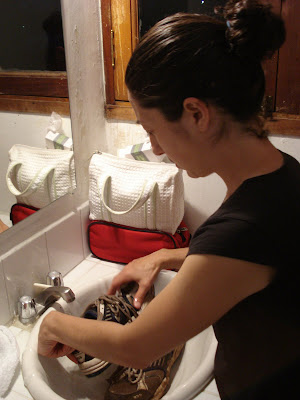
And then our hotel room flooded (we think from a leaky toilet tank), so we had to switch rooms, and our shoes stayed extra wet for a few days. But having flooded housing made us feel at home... just like Saginaw.
I realize this post is way too long, but to briefly describe our Sunday adventures:
 We went to the San Salvador Zoo, which actually was pretty good... especially for $.75
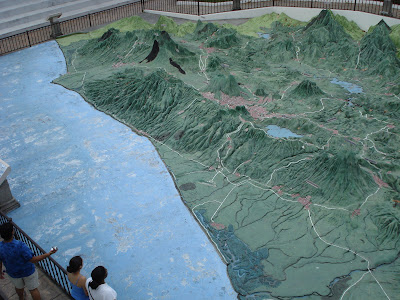 We went to the Military Museum (very pro-Arena), which featured a ginormous three-dimensional topographical map of El Salvador.
 It also had more guns than I'd ever seen before, from many different eras
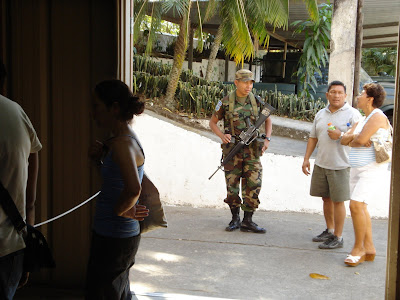 And lots of people around to answer questions... or enforce their funny rules (don't step past the yellow line, don't enter the green zone, don't wander behind the exhibit)... it was definitely still an active military site, not just a museum.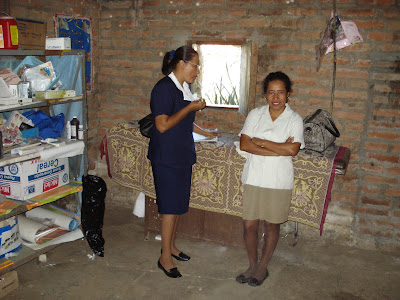
And back to work we went this week. Today, Alisha and Libby gave women PAP smears on this exam table (makes stirrups seem less unappealing?) while these local health workers taught breast exams and Neil and I advised the male and female elders in the community about their arthritis that is well controlled with their current medication, and the fact they get nervous sometimes, and yes, even about that fever they had two weeks ago that only lasted a day.
We tried going to Mayan ruins that are located near the clinic today, but we arrived at 3:30, and since they closed at 4:00, they obviously couldn't let us in. (how weird!) But we might try again later this week, so stay posted for more pictures, and also keep an eye out for Libby's wisdom regarding a four-country comparison.


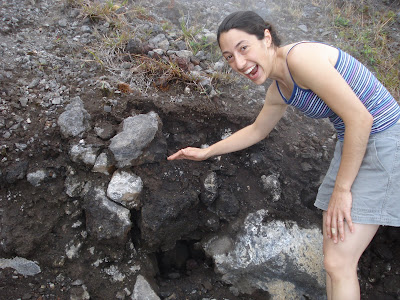 A view of the crater, and more steam vents!


